The Holy Grail is a legendary object associated with Christian imagery and the stories of King Arthur’s knights. Its familiar form is a sacred cup linked with Jesus’ Last Supper and his blood. Medieval writers, however, gave the Grail different forms, histories, and meanings. Understanding it requires distinguishing biblical passages, literary invention, religious symbolism, and claims made about surviving objects.
That distinction makes the subject more interesting. The Grail can be a vessel, a source of miraculous nourishment, the goal of a spiritual quest, or the focus of a modern adventure. Each version asks different questions about faith, desire, knowledge, and the kind of person who can attain what is sought.
The Biblical Background: A Cup and Joseph of Arimathea
In Luke 22:14–20, Jesus shares bread and a cup with his disciples and connects the cup with the new covenant in his blood. This passage provides part of the scriptural background for Christian communion and for later imagination about a sacred vessel.
John 19:38–42 describes Joseph of Arimathea obtaining permission to take Jesus’ body, and Joseph and Nicodemus preparing it for burial. The passage concerns the body, spices, linen, and the tomb. It does not describe Joseph collecting Christ’s blood in a cup.
Following these passages carefully helps identify what a later story adds. A romance can combine a biblical person and a sacred meal with a new narrative about the preservation and travels of an object. Its relationship with Scripture does not make every episode in that narrative part of the biblical account.
How Medieval Writers Developed the Grail
Alan Lupack’s account for the University of Rochester’s Camelot Project explains an important difference between early versions. In Chrétien de Troyes’ unfinished Perceval, the word “grail” refers to a dish or platter. The familiar identification with the Last Supper cup and the vessel for Christ’s blood is associated with Robert de Boron’s Joseph d’Arimathie, around the turn of the thirteenth century.
The change gives the object a more explicit connection with Christ’s passion. It links the adventures of Arthurian romance with a sacred history extending back to Jesus and Joseph. The resulting story invites readers to understand the quest through ideas of grace, holiness, and religious inheritance.
The differences also matter for interpretation. Asking what the Grail “really means” has no single answer independent of the work being read. A writer’s choice of object, characters, setting, and explanation helps determine the meaning of that particular version.
Why the Grail Is Not Always a Chalice
As the Camelot Project notes, Wolfram von Eschenbach’s Parzival presents the Grail as a stone associated with extraordinary nourishment and preservation of life. Its form differs markedly from a drinking cup.
This variation changes the questions a reader should ask. A vessel readily suggests receiving, containing, or sharing. A life-sustaining stone directs attention to another kind of marvelous power. Both can be placed within a religious narrative, but their imagery is not interchangeable.
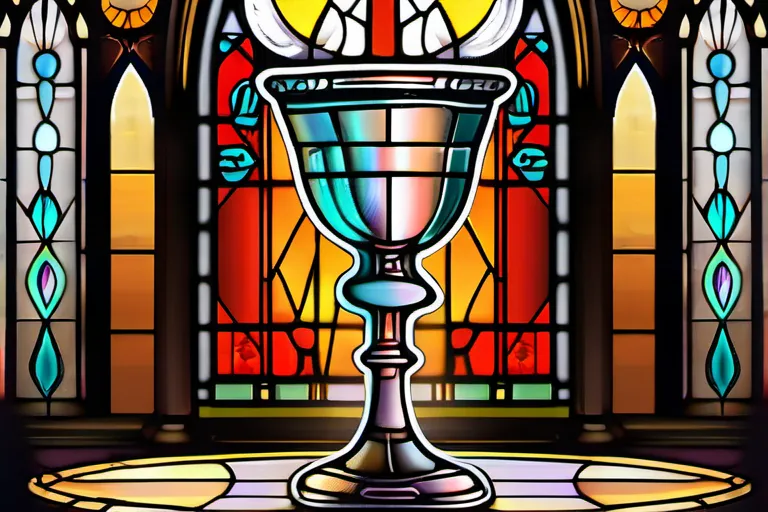
A modern illustration of a jeweled chalice may therefore represent one influential strand of the tradition while concealing others. For literary study, identifying the version is more productive than forcing every story into the image of one object.
Malory: A Quest That Tests More Than Fighting Skill
Thomas Malory’s Le Morte D’Arthur, especially Books XIII–XVII, provides a rich example of the Grail as a religious quest. At Camelot, the vessel enters the hall covered in white silk. The gathering experiences extraordinary nourishment, but the Grail remains concealed. Gawain responds by undertaking a quest to see it more fully.
The scene combines gift and longing. The knights receive something before they understand or possess it. Their desire then sends them away from the familiar setting of Arthur’s court into adventures whose significance requires interpretation.
Malory’s account also places moral and spiritual conditions beside martial achievement. In one encounter, a holy man tells Lancelot that sin obstructs his ability to see the Grail. The knight’s prowess does not settle the question of spiritual readiness.
Galahad, Perceval, and Bors have particular roles in the successful quest. The contrast among knights lets the story examine different kinds of aspiration and failure. It is a literary treatment of religious ideals, not a method for deciding whether an actual person’s hardship proves spiritual unworthiness.
Christian Symbolism and Eucharistic Meaning
The Grail’s association with Christ’s blood and miraculous nourishment gives it a strong relationship with Eucharistic imagery. Yet Christian teachings about communion should be described in their own terms. The Catholic Catechism, for example, explains the Eucharist through memorial, sacrifice, and Christ’s real presence. Reducing that account to a purely symbolic reminder would misstate it.
A Grail story can explore related ideas through narrative: who is invited, what is received, why the gift matters, and how the recipient should respond. A liturgical teaching explains a community’s worship; a romance develops characters and events. Their relationship is illuminating without making them the same kind of text.
The literary vessel can also suggest that what is most valuable cannot simply be seized by strength. In a story where the goal depends on grace or spiritual readiness, the quest challenges ordinary assumptions about ownership, conquest, and achievement.
The Antioch “Chalice”: An Object with Changing Interpretations
The Metropolitan Museum of Art’s Antioch “Chalice” shows why an object’s interpretation requires evidence. The museum dates the silver vessel to 500–550 CE and states that its identification as the Holy Grail has not been sustained.
The museum also explains that the object’s shape has been compared with sixth-century standing lamps. That interpretation changes how its decoration might be understood, including the relevance of Christ’s description of himself as the light of the world. The recorded place of origin also carries uncertainty.
The example separates several issues: the object exists; its materials and decoration can be examined; scholars can debate its function; and a claim about its use at the Last Supper requires additional support. An impressive appearance or a famous exhibition history cannot supply that missing connection by itself.
Valencia and the Question of Dating a Relic
A 2024 study by Manuel Zarzo, recorded by the Universitat Politècnica de València, examines the Holy Chalice preserved in Valencia Cathedral. Its abstract distinguishes an upper agate bowl from the vessel’s foot and gold stem and discusses the bowl’s features in relation to Hellenistic-Roman stone tableware.
The study investigates a particular question about material form and dating. That is different from demonstrating that Jesus used the bowl at a particular meal. An object may be compatible with an ancient period without having a documented connection to one named person or event.
This distinction allows religious devotion and historical investigation to be understood on their own terms. A community’s reverence for a relic is part of its religious life; a claim about the object’s origin and use must be assessed through the evidence available.
What Would Establish an Object’s History?
Several questions need separate answers. What is the object made of? Which parts belong together, and which were added later? What can its form and workmanship suggest about date and place? When does it first appear in a reliable record? How is the proposed history connected across the intervening centuries?
Different evidence addresses different questions. A dated inventory may show where an object was at that time. It does not automatically establish where it was a thousand years earlier. A similarity to ancient cups can support a discussion of type, while leaving the identity of a particular user unresolved.
The same reasoning applies to stories about hidden guardians or discoveries by famous orders of knights. A narrative can be examined as literature or as a later tradition. Establishing possession by a historical group requires evidence beyond the group’s appearance in a story.
The Grail in Modern Adventure
The story remains adaptable. Indiana Jones and the Last Crusade, released in 1989, makes the Grail the goal of an adventure involving Indiana Jones and his father. The film’s use of the object belongs to cinema’s imaginative treatment of the legend.
Such adaptations can shift the emphasis toward discovery, family relationships, danger, or the desire for extraordinary power. Their interest lies partly in how familiar imagery is used to ask new questions. They provide evidence of the legend’s cultural reception, rather than evidence for the ancient history of a surviving cup.
Reading the Quest as a Spiritual Metaphor
A Grail quest can be interpreted as a search for something that ordinary measures of success cannot provide. The pursuit may expose a character’s motives, challenge pride, or reveal the difference between wanting a sacred object and understanding the responsibilities associated with it.
This reading works best when it remains connected to a particular story. Malory’s concealed vessel and the knights’ unequal readiness give concrete material for reflection. A reader can ask what the character seeks, what changes during the journey, and whether attaining the goal means possession, insight, or a transformed relationship.
Conclusion
The Holy Grail brings together biblical imagery, medieval literary invention, religious interpretation, and later cultural adaptation. Its changing forms and the different demands of the quest are central to its interest.
Understanding it clearly means asking which story, teaching, or object is under discussion. That approach preserves the depth of its Christian symbolism while allowing historical claims about particular relics to be tested through their own evidence.
Published by Ralf. About our editorial process.