In Christian teaching, angels are created spiritual beings who serve God as messengers, worshippers, and ministers. They appear in biblical narratives of announcement, rescue, praise, and judgment. Later theology organizes these varied references into accounts of angelic orders, while art gives visible form to beings understood as spiritual.
These sources belong together, but they should be distinguished. A biblical passage, a church’s doctrinal statement, a theological hierarchy, and a painting do not provide the same kind of information. Understanding their relationship makes the subject clearer than treating every familiar angel story as a direct quotation from scripture.
Created beings, distinct from God and humanity
The Catholic Catechism, paragraphs 328–330, describes angels as spiritual creatures with intelligence and will. It explains “angel” in relation to their service as messengers. Angels are neither additional gods nor independent powers competing with the Creator.
A Reformed example is the Westminster Larger Catechism, question 16. It describes God creating angels as spirits who carry out his commands and praise him. Although Christian traditions differ over aspects of angelic devotion and explanation, these Catholic and Reformed accounts both locate angels within creation.
Angels should also be distinguished from human beings who have died. In Luke 20:34–36, Jesus compares the condition of the resurrected with angels in a discussion of death and marriage. A comparison does not mean that resurrected people become angels or must earn wings through good deeds.
These are theological claims about the nature of spiritual beings. They are different from an empirical demonstration that a particular reported encounter or unexplained event involved an angel.
Messengers in the stories of Jesus’ birth
In Luke 1:26–38, Gabriel is sent to Mary in Nazareth to announce the birth of Jesus. Mary is troubled, asks a question, receives an answer, and responds. The narrative gives the angel an important role, but the message concerns God’s action and Jesus’ identity.
Reading the exchange closely avoids filling it with imagined details about Gabriel’s voice, appearance, or emotional manner. The passage does not describe the encounter as either a whispered conversation or a thunderous spectacle. Its focus is the announcement and Mary’s response.
Luke 2:8–15 places the angelic announcement to the shepherds in the fields where they watch their flock. A multitude of the heavenly host then praises God. The shepherds subsequently go to Bethlehem. This sequence is different from placing the angels inside the birth scene with the shepherds already present.
Art and Christmas worship often bring these elements together. That can express the narrative’s religious meaning, but a combined scene should not obscure what the text actually says or where its different episodes take place.
Protection and guidance in particular narratives
Daniel 6:19–23 supplies a direct example of angelic protection: Daniel tells the king that God sent an angel to shut the lions’ mouths. The emphasis is on God’s deliverance, rather than an angel acting with authority independent of God.
In Acts 12:6–11, an angel wakes Peter in prison, tells him to dress, and leads him outside. Peter initially thinks he is seeing a vision; afterward, he recognizes the episode as deliverance. Guidance here takes the form of specific actions within the story.
Not every biblical rescue is described as an angelic intervention. Exodus 2:1–10 tells of Moses’ mother, his sister, and Pharaoh’s daughter preserving his life. An angel is not identified in that account. Recognizing the difference gives the human participants their proper place in the narrative.
These stories support Christian reflection on providence and help. They are not a guarantee that every faithful person will avoid imprisonment, injury, or death. A narrative of rescue cannot establish that someone who suffers lacked faith or angelic care.
Michael, Gabriel, and Raphael
Gabriel’s role as a messenger is explicit in Luke’s account. Michael appears in a different setting: Jude 9 calls him an archangel, while Revelation 12:7–9 portrays Michael and his angels fighting the dragon and its angels.
This is apocalyptic language about the conflict with evil. It should not be expanded into an undocumented military history or a general claim that Michael personally fought every battle later associated with his protection.
Raphael is prominent in Tobit. In Tobit 12:11–18, he identifies himself, explains his service, and directs attention toward blessing God. Tobit belongs to the Catholic Old Testament; it is absent from many Protestant Old Testament canons. That difference helps explain why Raphael’s scriptural role is less familiar in some Christian communities.
Named angels have distinctive roles in these texts. Turning those roles into exhaustive job descriptions, however, goes beyond what a single narrative establishes.
Where the nine angelic choirs come from
A widely known theological arrangement divides angels into nine choirs or orders. Chapter VI of The Celestial Hierarchy, by the writer known as Pseudo-Dionysius, presents three groups of three:
- Seraphim, cherubim, and thrones.
- Dominions, virtues, and powers.
- Principalities, archangels, and angels.
The work relates heavenly order to participation in and communication of divine illumination. It is a theological interpretation of names and scriptural imagery, rather than a single biblical passage listing nine ranks in this arrangement.
This distinction allows readers to appreciate the system without assuming that every Christian church requires the same detailed hierarchy. It also prevents a rank’s name from becoming an excuse to invent characteristics, personalities, or duties that the relevant sources never describe.
The names themselves need context. For example, Isaiah 6:1–7 portrays six-winged seraphim praising God’s holiness, with one bringing a coal to the prophet. The vision concerns holiness, purification, and prophetic calling. It is not a complete catalogue of the spiritual world.
What about fallen angels?
Christian accounts also distinguish the service of faithful angels from rebellion against God. Question 19 of the Westminster Larger Catechism describes some angels falling into sin while others remain in holiness. The Reformed explanation connects this with its wider teaching about divine providence.
Revelation’s picture of the dragon and its angels gives the conflict a dramatic narrative form. It does not portray evil as a second creator equal to God. Nor does it supply a reliable basis for assigning every personal difficulty to a particular invisible being. Theological reflection on spiritual conflict and a claim about the cause of an individual event require different kinds of argument.
Angels point beyond themselves
Hebrews 1:5–14 distinguishes the Son from angels and describes angels as ministering spirits. Within this Christian argument, angels serve the divine purpose; Christ’s status is not simply that of a particularly powerful member of their order.
The distinction also shapes worship. In Revelation 22:8–9, an angel refuses John’s act of worship and directs him to worship God. Christian attention to angels therefore has a limit grounded in their status as fellow servants.
Catholic practice includes seeking angelic assistance and honoring guardian angels. The Catechism’s paragraphs 334–336 place this within the church’s worship of God and describe angelic care throughout human life. Such devotion should be identified in its particular Christian setting rather than presented as a uniform practice across all churches.
Why angels have wings in Christian art
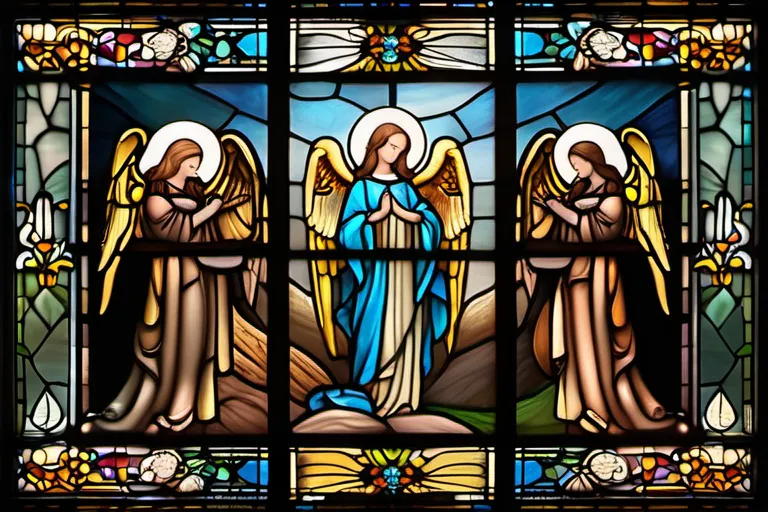
Artists make spiritual realities visible through bodies, clothing, wings, gestures, and objects. Some biblical visions explicitly include wings, as Isaiah’s seraphim do. Other narratives, including Gabriel’s announcement to Mary, do not provide a comparable physical description.
A concrete example is the National Gallery’s catalogue discussion of Fra Filippo Lippi’s Annunciation panel. It describes Gabriel with elaborate peacock wings and a stem of lilies. These choices belong to the painting’s visual and devotional language; Luke does not specify peacock feathers or lilies.
A painting may therefore be valuable evidence for how a Christian community imagined and honored angels without functioning as an eyewitness record of an angel’s anatomy. Reading the artwork and its biblical source together reveals both continuity and interpretation.
Conclusion

Angels matter in Christianity because their service directs attention toward God’s action: announcing, praising, protecting, guiding, and participating in judgment. The biblical examples are varied, and later theology and art develop them in different ways.
A careful understanding keeps those layers distinct. It recognizes a theological hierarchy as a theological hierarchy, a sacred image as an interpretation, and a rescue narrative as a particular story rather than a promise of immunity from harm. Across these differences, the central pattern remains service to God rather than fascination with angels as independent spiritual powers.
Published by Ralf. About our editorial process.