
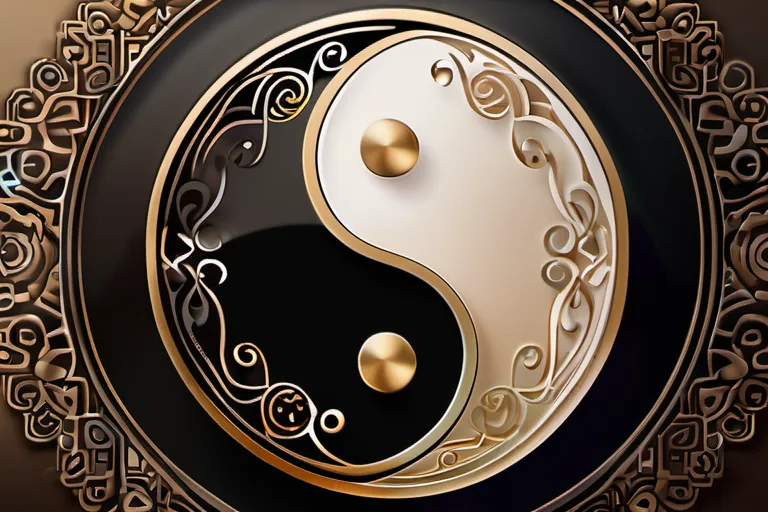
The yin-yang symbol represents a relationship between contrasting but interdependent aspects of existence. In Daoist interpretation, it can express how change and harmony arise through their interaction. The dark and light areas belong within one circle, while each contains a small area of the other colour.
Its significance becomes clearer when three things are distinguished: the concepts of yin and yang, the history of the diagram, and the uses of both within Daoism and wider Chinese thought. They are connected, but they do not all have the same origin or one fixed interpretation.
What do yin and yang mean?
Yin is associated with shade, darkness and stillness; yang with sunlight, brightness and activity. These associations give a starting point for understanding relationships, rather than a list dividing the world into two completely separate substances.
Robin R. Wang’s account in the Internet Encyclopedia of Philosophy traces early uses of the terms to natural phenomena, including the shady and sunny sides of a hill. The hill provides a helpful example: the difference between shade and sunlight does not require two independent worlds.
Wang also emphasizes that yinyang belongs to several schools of Chinese thought. It should not be treated as an idea owned exclusively by Daoism or as a decorative shorthand for everything Chinese.
Nor do dark and light simply mean evil and good. The relationship concerns contrast, interdependence and change. Turning it into a battle in which the light must destroy the dark would lose the significance of their belonging together.
Reading the circle, curves and dots
The familiar image is often called a taijitu, a diagram associated with taiji. Its circular boundary contains two curved areas, conventionally black and white. The black area contains a white dot, and the white area a black dot.
The Art Institute of Chicago’s exhibition on Daoist cosmology explains the dots through the interdependence of yin and yang and the beginnings of one within the other. The image thus conveys more than a division into opposing halves.
Read together, its features suggest a connected process: difference appears within a whole, and neither side is represented as entirely without its counterpart. The curved boundary also allows the eye to follow a changing relationship rather than a rigid partition.
This is an interpretation of a philosophical diagram. It should not be mistaken for a literal picture of the universe or a numerical measurement of two ingredients in every object. The image organizes an understanding of change; it does not replace an explanation of the particular thing being considered.
Why context matters
In the introduction to her book Yinyang, Wang argues that the concepts apply within particular relationships and circumstances. A thing can be described differently when the comparison or function changes.
This is more precise than assigning every person or object one permanent label. Before calling something yin or yang, it matters to ask: in relation to what, and in which respect? A description of relative warmth is not automatically a description of social authority or moral character.
Traditional correspondences include feminine and masculine associations, but those associations alone do not establish that every woman must be passive or every man active. Treating the terms as fixed personality types would remove the contextual dimension of the explanation.
As a simple illustration, imagine comparing a sheltered courtyard with a brightly exposed terrace. Their contrast draws attention to conditions and relationships. It need not turn either place into a timeless embodiment of one quality, regardless of the weather, hour or use.
Balance involves change, not a frozen halfway point
The seasonal cycle is a recurring way of explaining the relationship. Chicago’s exhibition describes the beginnings of one tendency appearing as the other reaches its height and declines. Winter and spring provide a sequence of transformation, rather than two conditions that must be present equally at every moment.
This helps explain why “balance” need not mean a permanent fifty-fifty allocation. A cycle includes different phases, and harmony concerns their relation and appropriate movement. An image of equal-looking areas does not establish that every practical decision requires identical quantities on both sides.
For example, describing rest and activity as complementary does not tell a person exactly how many hours to assign to each. That question requires attention to their actual activity and circumstances. The philosophical insight concerns a relationship; it is not a complete timetable.
The old concepts and the later diagram have different histories
Ancient textual references to yin and yang do not prove that the familiar black-and-white swirl already existed in the same form. The history of a concept must be separated from the surviving history of its images.
In his 2003 study “The Genesis of an Icon”, François Louis examines the history of the combined diagram of a yin-yang circle and surrounding trigrams. He argues that the two components had distinct visual histories, and that textual evidence points to their combination in the fourteenth century.
Louis distinguishes these textual indications from later surviving material evidence and examines stories giving the diagram an ancient pedigree. His research cautions against assigning the familiar design a simple origin in the second century BCE.
There were also several diagrams bearing the name taiji diagram. A reference to one of them does not automatically identify the particular swirl familiar today. Asking which image, text or surviving object is meant makes the history more intelligible than looking for one universally agreed inventor.
Daoist and Confucian uses
Yin and yang feature in Daoist cosmological language, but their significance extends beyond one tradition. Joseph A. Adler’s translation and discussion of Zhou Dunyi provides a concrete Confucian example.
Zhou’s Explanation of the Diagram of the Supreme Polarity describes activity and stillness as alternating and providing a basis for one another. It links yin and yang, the Five Phases and the generation of things, then relates the account to human moral cultivation.
The work became important within Neo-Confucian thought through Zhu Xi’s interpretation. Adler also discusses its Daoist connections and the disputes surrounding its use. The example shows ideas moving through overlapping intellectual traditions rather than remaining inside a sealed religious category.
The Yijing, also known as the I Ching or Book of Changes, belongs to this wider background. Its configurations of broken and unbroken lines are related to yin-yang interpretation, but a hexagram is a different graphic form from the two-part circle.
A textual example: the Daodejing
Chapter 42 of the Daodejing, in James Legge’s translation, describes the emergence of multiplicity from the Dao and presents things in relation to obscurity, brightness and harmonization. Different translations render the terminology differently, which matters when a short English quotation is treated as the whole teaching.
The passage places the relationship within an account of how the world comes to be and functions. It does not merely recommend a pleasant mood or an aesthetically balanced room.
Daoist writings approach the world through varied images and arguments. Reading a passage in its context allows those differences to emerge, instead of treating every image as another way of saying that everything should be balanced equally.
A concrete example in Daoist art
Yin-yang ideas need not appear as a literal circle to inform an artwork. The Metropolitan Museum of Art’s essay on Daoist art connects the shape of Wu Boli’s Dragon Pine with the double-S curve of the diagram.
The museum’s record for the painting dates it to the late fourteenth or early fifteenth century. It identifies Wu Boli as a Daoist priest and explains that the work was made for Zhang Yuchu. Its account relates the animated tree to moral character, the perfected being and Daoist geomantic beliefs.
This is a specific artwork with an identifiable setting and documented interpretation. It shows why reading Daoist art requires more than identifying any curved shape as a universal symbol of balance.
Conclusion
The yin-yang symbol offers a compact way to think about contrast, interdependence and transformation. Its two areas and contrasting dots express a relationship within a whole, rather than a contest between pure good and pure evil.
Its meaning becomes richer when connected to texts, historical diagrams and particular artworks. The ancient concepts, later visual forms and diverse Daoist and Confucian interpretations together explain its importance. Reducing it to a fixed personality test or a slogan about balancing everything equally would overlook that depth.
Published by Ralf. About our editorial process.



