
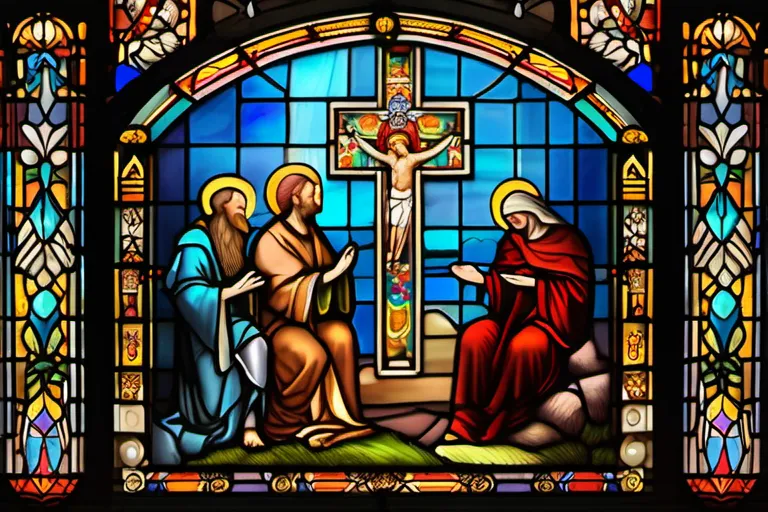
Art can give religious stories a visible form, help organise worship, focus devotion and transmit skills and memories within a community. Its role extends from paintings and sculpture to architecture, calligraphy, music and movement. These forms do not all work in the same way or carry the same meaning in every tradition.
A useful starting point is to ask what people do with a work. Looking at an image in a museum, carrying it in a procession, reading its inscription and participating in a ceremony are different activities. The material object and the religious setting help explain one another.
Art tells stories and preserves particular memories
A medieval stained-glass window can place a narrative within a worshipping community’s surroundings. The Metropolitan Museum’s Scenes from the Legend of Saint Vincent of Saragossa and the History of His Relics, dated about 1245–1247, originally belonged to the abbey of Saint-Germain-des-Prés in Paris.
The museum connects the scenes with the abbey’s particular devotion to Vincent and the history of a relic associated with him. The subject therefore concerns both a saint’s story and the identity of a specific institution. The images make that connection available for attention and remembrance.
This helps explain why religious narrative art is more than a generic illustration of “belief.” Choices about which person, event or episode to depict connect the work with particular forms of devotion and communal memory.
Images can participate in worship
The Met’s Shiva as Lord of Dance, a copper-alloy image from Tamil Nadu dated to the late twelfth or early thirteenth century, offers a different example. Its form brings together Shiva’s roles in creation, preservation and destruction. The drum and fire contribute to that religious imagery.
The museum explains that images of this kind were taken in festival processions so that the public could see them. Their significance therefore included movement through a community, rather than only their appearance as stationary sculptures.
Knowing about that use changes the questions a viewer asks. Craftsmanship, posture and iconography remain important, but so do festival participation and the relationship between the image and those who encounter it. A single sculpture also represents a particular devotional form; it should not be treated as the complete explanation of every Hindu tradition.
Calligraphy can unite text, function and symbolism
Religious meaning need not depend on depicting a human figure. The Met’s teaching material on Islamic religious art examines a mosque lamp made in Egypt around 1329–1335. Its glass, enamel, gilding and inscriptions combine skilled making with the practical provision of light.
The account connects mosque lamps with Quran 24:35, the Light Verse, and identifies the patron of this example through its inscription and emblem. Light, sacred language and patronage come together in one object.
The lamp shows why separating “useful object” from “religious art” too rigidly can be misleading. An object can illuminate a building while its decoration directs attention to a religious text and records the person who commissioned it. Its different functions reinforce one another without becoming identical.
Making and dismantling can both have meaning
Some religious artworks are created for a limited duration. The Smithsonian’s account of a Tibetan sand mandala describes a geometric composition associated with a sacred arrangement of deities. Its preparation involves ritual, careful drawing and the placement of coloured material.
After serving its purpose, the finished mandala is swept up and the material dispersed in flowing water. The account explains this dismantling in relation to impermanence. The work’s destruction belongs to its religious significance rather than representing a failure to preserve a finished product.
This example expands the meaning of artistic achievement. Patience, precision, ritual preparation and relinquishment all matter. Evaluating the work only by how long it survives would miss an essential part of the practice.
Music and movement transmit religious learning
Religious art also includes activities learned and performed by people. UNESCO’s description of the Mevlevi Sema ceremony links whirling movement with a defined musical repertoire and the traditions of the Mevlevi Sufi order.
Its account of historical training connects prayer, poetry, music and dance with ethics, conduct and belief. The ceremony therefore involves more than spectators seeing a striking movement. It belongs to a setting of instruction and participation.
UNESCO also discusses how performances can change when removed from their earlier religious setting and adapted for audiences. This makes context part of understanding the art. The same recognisable form may be encountered as a practice within an order, a cultural presentation or a shortened performance, with different expectations surrounding it.
Religious communities make choices about art
Traditions establish standards for which forms belong in worship and how they should be used. The Catholic constitution Sacrosanctum Concilium, sections 122–124, connects sacred art with the dignity of worship. It recognises styles from different periods and permits contemporary art that serves the religious setting appropriately.
The document also distinguishes beauty from lavish display. That gives an identifiable example of a religious institution evaluating art by more than expense or technical virtuosity. Questions of suitability concern the practice the art is intended to serve.
This is a Catholic account, not a rule shared automatically by every religion or every Christian denomination. It illustrates why understanding religious art involves attention to the community’s own judgments as well as the artist’s choices.
One visual rule cannot describe an entire tradition
Broad labels can conceal variation. The Met’s exhibition account of figural representation in Islamic art documents human and animal imagery in different periods and cultural settings. That evidence complicates a blanket claim that all art produced in Islamic societies excludes figures.
It also shows why the context of a particular object matters. A calligraphic lamp associated with a mosque and a figural object made for a different setting cannot simply be assigned the same function. Period, place, use and audience are part of the explanation.
The same care applies more widely. A term such as “Christian art,” “Hindu art” or “Buddhist art” identifies a field of inquiry; it does not supply a complete account of every work within it.
How to understand a religious artwork more fully
Several questions bring its roles into focus. What story, text or being does it concern? Who made and commissioned it? Where was it placed? Was it carried, touched, sung, read or dismantled? What explanations do participants give for its use?
The examples above answer those questions differently. A narrative window connects an institution with a saint’s memory. A processional image enters public religious life. A lamp joins illumination with inscription. A mandala gives impermanence a carefully made form. A ceremony transmits learning through repeated, embodied practice.
Those differences make religious art a useful way to understand communities without reducing their lives to written doctrines alone. They also preserve the distinct religious commitments that give particular forms their meaning.
Conclusion
Art serves religion through storytelling, worship, devotion, remembrance and participation. Its meaning emerges from the relationship between a work’s form, the activities surrounding it and the people who interpret and use it.
Concrete examples reveal a range of possibilities: an artwork may endure for centuries, move through a festival or be deliberately dismantled. Understanding those roles gives a fuller account of religious art than assuming every work is decorative, every symbol is universal or every tradition uses images in the same way.
Published by Ralf. About our editorial process.



