
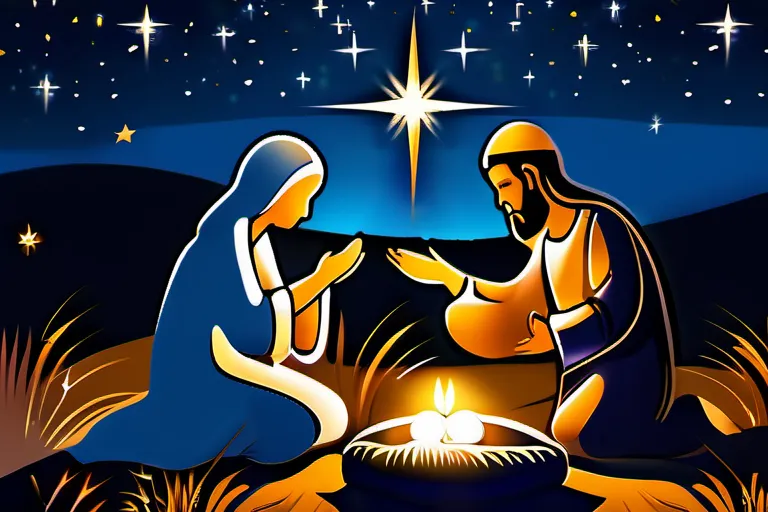
Christmas Eve is the evening on which many Christian communities begin celebrating the Nativity of Jesus Christ. It brings Advent’s waiting into Christmas through worship, biblical readings, music, and gatherings at home. In mainstream Christian theology, its central meaning is the Incarnation: the belief that God the Son became human in Jesus.
The occasion takes different forms. A late-night Eucharist, a service of readings and carols, and a family’s Christmas meal express related themes through distinct practices. Their significance becomes clearer when the Gospel narratives, church services, and regional customs are considered in their own settings.
The birth narratives behind the celebration
Luke 2:1–20 describes Mary and Joseph traveling to Bethlehem, Jesus being laid in a manger, and shepherds receiving an angelic announcement while keeping watch at night. They visit the child and return praising God. Mary, meanwhile, reflects on what has happened.
The narrative connects an extraordinary announcement with ordinary and vulnerable circumstances. A child is placed in a feeding trough, and the news reaches people watching their animals. Christian readings of Christmas draw themes of humility, joy, and divine concern for human life from this account.
Matthew 1:18–25 gives particular attention to Joseph, a message received in a dream, and the naming of Jesus. It interprets the birth through the name Emmanuel, meaning God’s presence with his people. The next chapter introduces visitors from the east and the star (Matthew 2:1–12).
The star and the shepherds therefore come from different Gospel accounts. A nativity display may place them together as an artistic expression of the wider story, while a careful reading keeps each narrative’s sequence and emphasis visible. Neither account specifies December 24 as the child’s historical birth date.
Why the Incarnation matters
John 1:1–14 expresses the theological meaning of Christ’s coming through the Word becoming flesh and dwelling among humanity. It also connects life and light with the Word. This helps explain why Christmas services combine the story of a birth with claims about God’s relationship to the world.
Within this Christian understanding, the Nativity expresses God’s entry into human life. The child’s dependence, family relationships, and material surroundings become occasions for reflection on humility and care. This theological interpretation gives Christmas Eve a meaning that extends beyond anticipation of the next morning’s celebrations.
Evening worship and the Christmas liturgies
Christmas Eve services can begin celebrating the feast while the civil calendar still reads December 24. The Church of England’s guide to Christmas worship describes Midnight Mass as a late-night service that may continue past midnight. It normally includes carols, a short address, and Holy Communion.
The name identifies a familiar pattern of Christmas worship, while local arrangements determine the precise service time. Its Eucharistic character matters: the congregation celebrates Christ’s coming through shared prayer, proclamation, and the sacramental meal.
Roman Catholic worship also gives the Nativity several liturgical settings. The US bishops’ lectionary for Christmas distinguishes the Vigil Mass from Mass during the Night, at Dawn, and during the Day. The Vigil’s Gospel is from Matthew 1. The Mass during the Night uses Luke’s account of the birth and the angelic announcement.
These distinctions explain why people attending different Christmas services may hear different readings. The feast is approached through several scriptural perspectives, and Christmas Eve forms part of that larger celebration.
Lessons and carols: a documented tradition
A service of lessons and carols offers another influential form. King’s College Cambridge records that its Festival of Nine Lessons and Carols began on Christmas Eve 1918 under Dean Eric Milner-White. It adapted an order associated with E. W. Benson at Truro in 1880. Broadcasting began in 1928 and helped the service reach wider audiences.
Its structure alternates biblical readings with music. The college emphasizes the readings and prayers as the service’s backbone, even while individual carols change. The result is a sequence of listening and response in which music helps a congregation consider the Christian story.
This example also shows how a recognizable Christmas custom can have a traceable institutional history. Its wide adoption and adaptation do not make every Christmas Eve service identical, and a carol service has its own purpose alongside a Eucharistic celebration.
The crib and a Christian way of looking at the world
The nativity scene brings figures, animals, and a manger into a visual arrangement. In his 2019 letter Admirabile signum, Pope Francis explains the crib as an invitation to contemplate the Incarnation. He recalls Francis of Assisi’s Christmas celebration at Greccio in 1223, with a manger, hay, an ox, and a donkey.
The letter also describes families passing on the custom and using varied materials and imaginative settings. In this account, making a crib helps people enter the story through attention and memory. Its purpose is devotional and educational.
A display’s figures can consequently express several layers of tradition. They may bring together Gospel details, later artistic conventions, and the community’s own surroundings. Understanding those layers allows the scene to be appreciated as an interpretation with a history.
A regional example: the Polish Christmas Eve table
The Adam Mickiewicz Institute’s Culture.pl account of Polish Christmas Eve describes sharing opłatek, an unleavened wafer, before the meal. Those gathered break and exchange pieces while offering one another good wishes. The custom gives a family gathering an explicit moment of mutual acknowledgment.
The same account describes leaving an additional place at the table for someone needing hospitality. The place expresses readiness to welcome another person, connecting celebration with an obligation of care. These are examples of Polish traditions, with variation among households.
The wafer shared at home belongs to that domestic custom. A St. Theresa parish explanation specifically distinguishes these wafers from consecrated Communion hosts. Regional Christmas practices can use related symbols while serving different roles.
Calendars and different Christmas Eves
The civil date depends on the church calendar being followed. An Orthodox Church in America teaching manual explains that churches using different calendars can both identify Christmas as December 25 while observing it on different civil dates. Under the present calendar difference, Julian December 25 corresponds to Gregorian January 7.
For communities following that Julian date, Christmas Eve consequently falls on January 6 in the Gregorian calendar. Other Orthodox communities celebrate on Gregorian December 25. The distinction is about calendars within Orthodox practice, rather than a single January observance shared by every Orthodox Christian.
This also helps explain why December 24 should be used with attention to context. It is the Christmas Eve familiar in many Western settings, while the broader Christian world includes other calendrical arrangements.
Faith, hospitality, and differing experiences
The examples above connect Christmas Eve with several kinds of participation: listening to scripture, singing, sharing Communion, making a crib, and welcoming others at a table. Each gives a community a way to express beliefs and transmit traditions.
Participation does not require assuming that everyone experiences the evening alike. Family celebrations may also bring absence, grief, or practical difficulty into view. The themes of humility and hospitality provide a reason to consider who is included and how care can extend beyond the celebration itself.
Conclusion
Christmas Eve brings the anticipation of Advent into the celebration of Christ’s birth. Its religious significance rests on the Incarnation, while its services and customs give that belief visible, audible, and communal forms.
Keeping the distinctions clear enriches the occasion: Gospel narratives explain the biblical foundations, liturgies shape worship, and regional customs carry memory and hospitality. Together they show how a Christian feast becomes part of both congregational life and the home.
Published by Ralf. About our editorial process.



